a biography of the Mountbatten drum kit
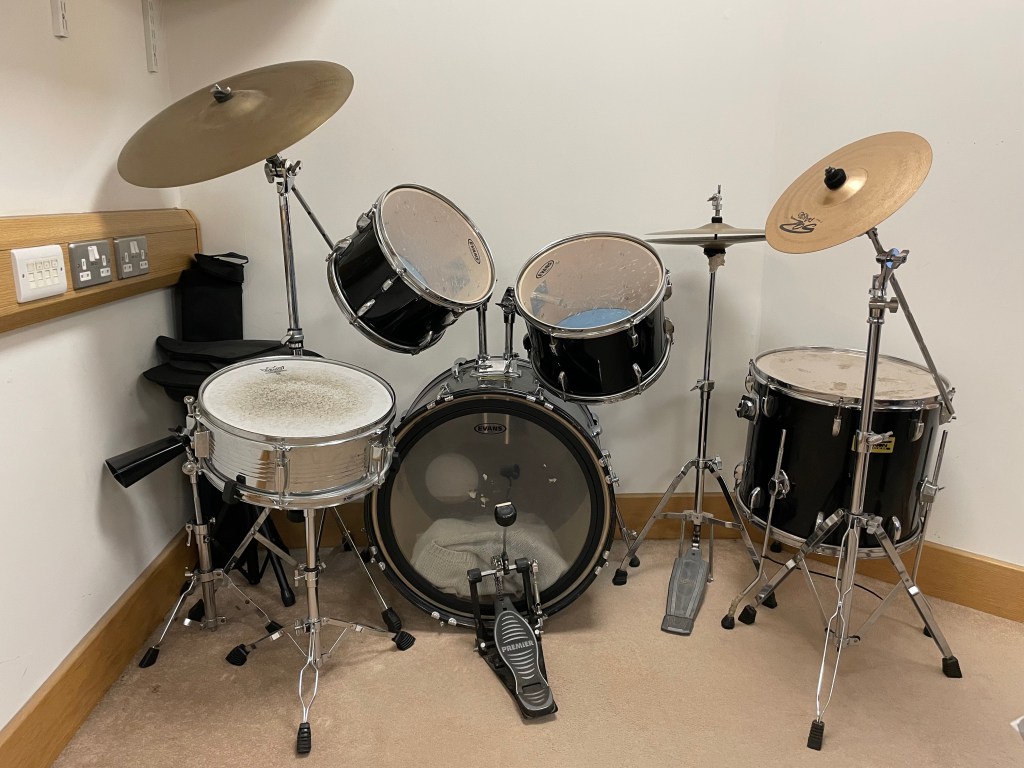
When Tia met with Fraser Simpson at Mountbatten last month, they were surrounded by musical instruments in the music room. They got to talking about some special instruments that have been donated to the hospice, such as the Moody Blues piano. Fraser pointed to the drum kit in the corner….
Scholars who study how memories are made typically point to the importance of material objects as anchors of how and what we remember. The Italian memory studies expert, Anna Lisa Tota, has written about how objects can become “technologies of memory” which, “shape the content of memories” (Tota and Hagen 2015). Technologies of memory play an important role in institutions (hospitals, hospices, schools, care homes, the military, churches, courtrooms, convents, and governing bureaus…). In such settings, materials such as furnishings, symbols, and artworks inscribe memories and music therapists know this well…
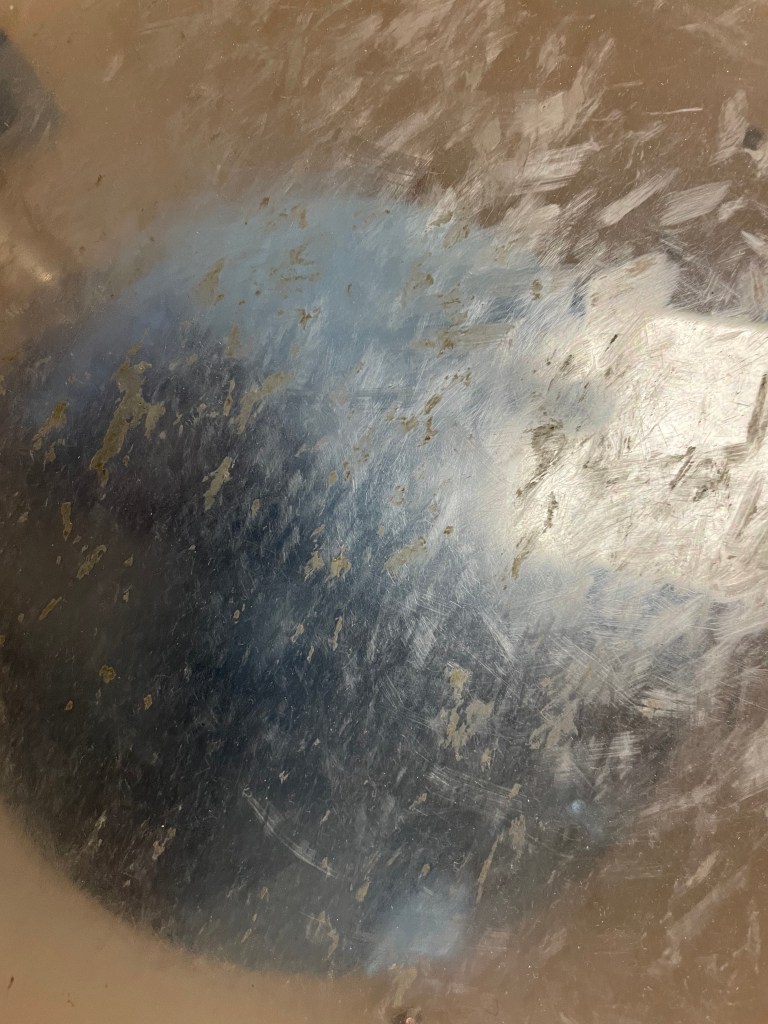
In an ethnography of music therapy of a Norwegian prison, Kjetil Hjørnevik considers these issues. Stories, he says, are one way of making, sharing and retaining memory, but memories are also inscribed directly on and into objects through the ways objects are used, by whom, where, and by how many. Memories, and remembered practices can be detected through clues they exhibit of former practices and former activities. So, for example, the patches of erosion on the neck of a well-used prison guitar offer visible traces of repeatedly played chords. As Hjørnevik says:
“The guitar did not kiss and tell, but it was marked by wear and tear, evidencing its usefulness and mediating its own story of musical intimacy and versatility (Hjørnevik 2021: 227).”
There is much to learn, in other words, from closely examining the traces of use exhibited by an object over time. These ‘unobtrusive measures’ of patterned social activity can point to shared histories and shared memories. The worn patches on the neck of a guitar. The chewed tops of wooden recorders in schools (in days gone-by, before plastic, washable instruments arrived on the scene). Or the marks or mending on a piece of sheet music, described by Philip Larkin in Love Songs in Age:
She kept her songs, they kept so little space,
The covers pleased her:
One bleached from lying in a sunny place,
One marked in circles by a vase of water,
One mended, when a tidy fit had seized her,
And coloured, by her daughter –
So they had waited, till, in widowhood
She found them….
*
As Fraser commented, when we sat in the music room, the Mountbatten drum kit had seen a lot of use. Indeed, the Care for Music Team had already met this drum kit and one of its players, Bette, a woman who made music with Fraser at Mountbatten….
*
In her eighties, Bette wanted to learn the piano for years. Music and dance had been an important part of her life. She went to the hospice to consult their music therapist, Fraser, with the hope that he might teach her how to play. She then went weekly from Oct 2020-July 2021. However, Bette was weak due to a respiratory illness, severe arthritis and Parkinsons Disease. She used a wheelchair to get about. She and Fraser spent the first few sessions trying hard to make headway at the piano but Bette’s fingers were stiff and depressing the keys was difficult. She kept trying even though hand movement was so difficult.
Which was why, right from the very first session, Fraser also introduced some percussion work on the basis that the gross motor control it required was relatively more manageable. At first Bette was not convinced – she hadn’t come to learn the drums! But together, Bette and Fraser discovered that in drumming, Bette could achieve a degree of musical ‘flow’ impossible at the piano. And, as Bette said, there were ‘no notes on a drum to get right – or wrong’. Fraser improvised at the piano, picking up Bette’s tempos and musical ‘gestures’, developing these into musical structures that helped her to organise her playing.

Over the weeks and months, the focus of their work became about developing her capacity for coherence and control. It was not a steady arrow of progress, and there were weeks when everything seemed stiffer. Frequently Bette would suggest that she was wasting Fraser’s time and that he should offer the weekly time slot to somebody else.
Over time, however, Bette’s playing developed. Increasingly, she could hold a pulse, imitate rhythmic patterns, change tempo up and down without losing control, and play with strength and confidence. Together, she and Fraser moved through lots of different dance idioms – waltzes, marches, habaneras and jazz.
About six months after they had begun, Fraser asked Bette her favourite instrument (she had just asked him the same question). Her answer came, without hesitation, ‘the drums!’.
Bette died in August 2021.
*
The drum kit made its first appearance at Mountbatten when its owner, a drummer, moved in to the hospice as a residential patient. After he died, the man’s family asked if the hospice might like to keep the drum kit. And so, it remains. The drums are played and enjoyed by many. The instrument reminds Fraser of its original owner when it is used. And the drumskin, seen below in close-up, reveals the unobtrusive measures of the pleasure it has given so many over the course of its rich career.
The beat goes on….
 Island Life and Death
Leave a comment