How might trying to be creative help to address loss?
1991. Tia was a University of Wales Fellow at Cardiff University. Among other things she got involved in the Women’s Studies MSc program. It was there that she supervised her first-ever Masters dissertations, including a beautiful study, entitled, Living and Dying with Breast Cancer.
Andrea, who was then, herself, living and dying with breast cancer, chose to write her masters about how to craft networks of friends and family to empower, accompany and care for each other in scenes of life-limiting illness. Her MSc described how she took comfort in the ways that her support network remained practical and matter-of-fact in the face of her illness and how it was important for her, the person who was gravely ill, to find tactful but honest ways of expressing what she might need and want (and not want). Andrea hoped that there would be lessons about network building that could be of help perhaps to others, and lessons about grass-roots women’s mutual aid. She also hoped that her own support network might provide the basis for mutual consolation after her death.
As it happened, Andrea never quite completed the final chapter (she died while still writing up) but she was awarded the degree posthumously. Later, the Guardian did a feature on her work. So today, as Tia reflected on the equinox, she remembers three things…
The first thing is that she wonders if she might have done better in the academic role of supporting Andrea (one of the senior members of the MSc supervisory team was the one who went to visit Andrea nearer to the end). Better able, perhaps, to have talked openly with Andrea about death and dying. To have taken on board the very lessons Andrea’s work offered, in fact …
The second thing Tia remembers is taking part in a bereavement and death-awareness workshop. The event was organised and run by one of the students on the course, a counsellor working with people affected by cancer. We were at Gregynog, a University of Wales Trust property and a beautiful place for conferences and seminars. It was our annual Women’s Studies Retreat.
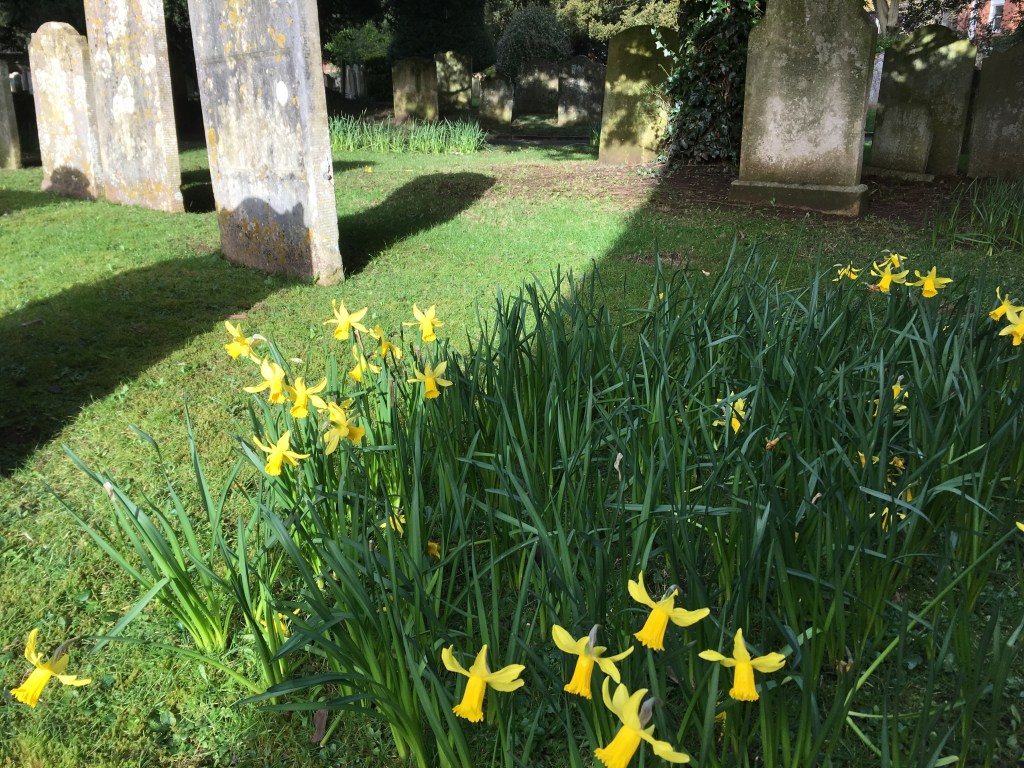
This was Tia’s first experience of a bereavement workshop. It was an intense morning and the rain came down in buckets. It was – the first day of spring. The estate and grounds were glorious. After the workshop, and after the lunch, there was break-away time. People went off to be quiet and reflect. Tia went out for a hike up the hill and came back into the beautiful main lounge for tea where there were vases and vases of daffodils in bloom. In response, Tia wrote a poem, which (she now supposes) she did as a way of trying to process the hard-to-pin-down or hard to articulate issues that had bubbled up in the morning’s workshop (and which thirty-something years on, she could still type out from memory).
Thinking about writing that poem led to the third thing Tia is remembering today – that trying to make something creative can also be a way to come to terms with loss, grief and challenging situations. There are of course lots of ways to be creative – a poem, story, knitting, woodworking, embroidery, cooking, drawing, gardening, playing music or song-writing, and many more that Tia cannot currently imagine…. Any of them potentially offer a medium for remembering and commemorating.
This is one reason Island Life and Death focuses on community arts and creativity. Creations of whatever kind can cast and re-cast issues and problems. For example, a metaphor or simile draws a connection between one thing and another, re-presenting both those things in a particular light (‘my love is like a red, red rose…’). It is not important to make a ‘good’ poem (who is to say if it is or is not ‘good’ anyway?). What is important is how being creative can help us find ways of depicting, drawing out and containing issues or events. And if we can do that, we have also found new ways of understanding and communicating about those events. It was like this, we can say, no, it was like…. And so we enrich how we might talk (with each other) about death, dying and bereavement, the available vocabularies for that work.
Thus, on the first day of spring, and Andrea, after many years….
At Gregynog, on the first day of Spring
We made a circle and thought about you.
Our hopes and fears for our own deaths stirring,
We worked. I held the hand of someone new,
Gazed out the window into sheets of rain,
And talked about my own imagined death
As a confused mixture of joy and pain.
After lunch, we dispersed. Walking, my breath
Came fast. I reached the place where the estate
Ended. The hedgerow would not let me pass.
Arriving back for tea, and slightly late
I noticed vases by the looking glass
Brimming with daffodils and all in bloom,
There to illuminate our Common Room.
 Island Life and Death
Leave a comment