at Mountbatten, the idea of ‘concert’ and social virtuosity
Tia was at Mountbatten three weeks prior to the winter Solstice. These are the darkest days of the year. They are connected, in many faiths, with festivals of light and fire. Last week, the first week of Advent, Mountbatten was ablaze with lights….

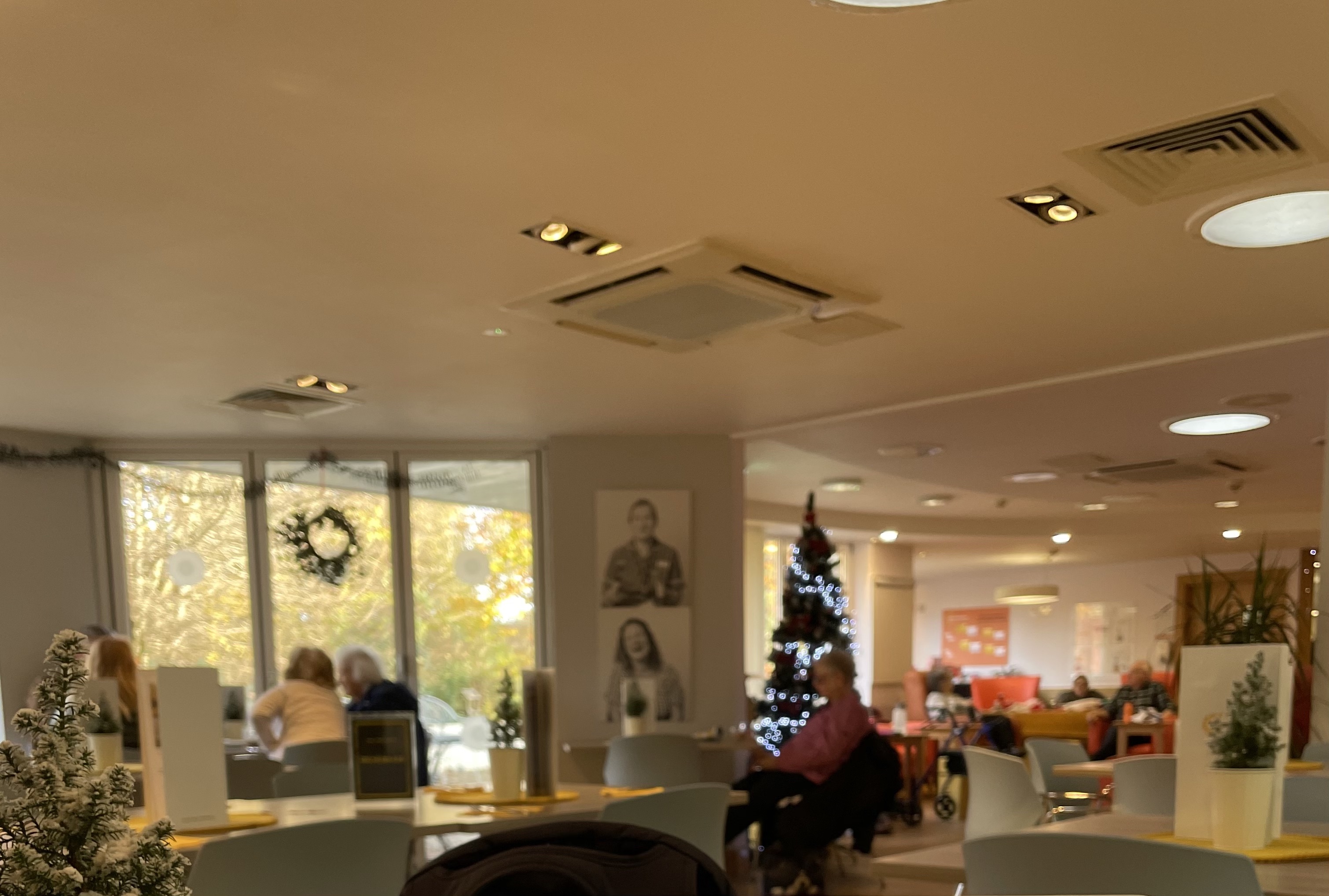
Outside, the tree is lit. Inside, there are at least six (donated) Christmas trees, not counting 16 living mini-trees, one on each table in the café. “There’s no shortage of Christmas trees here,” someone commented as they walked down the corridor.
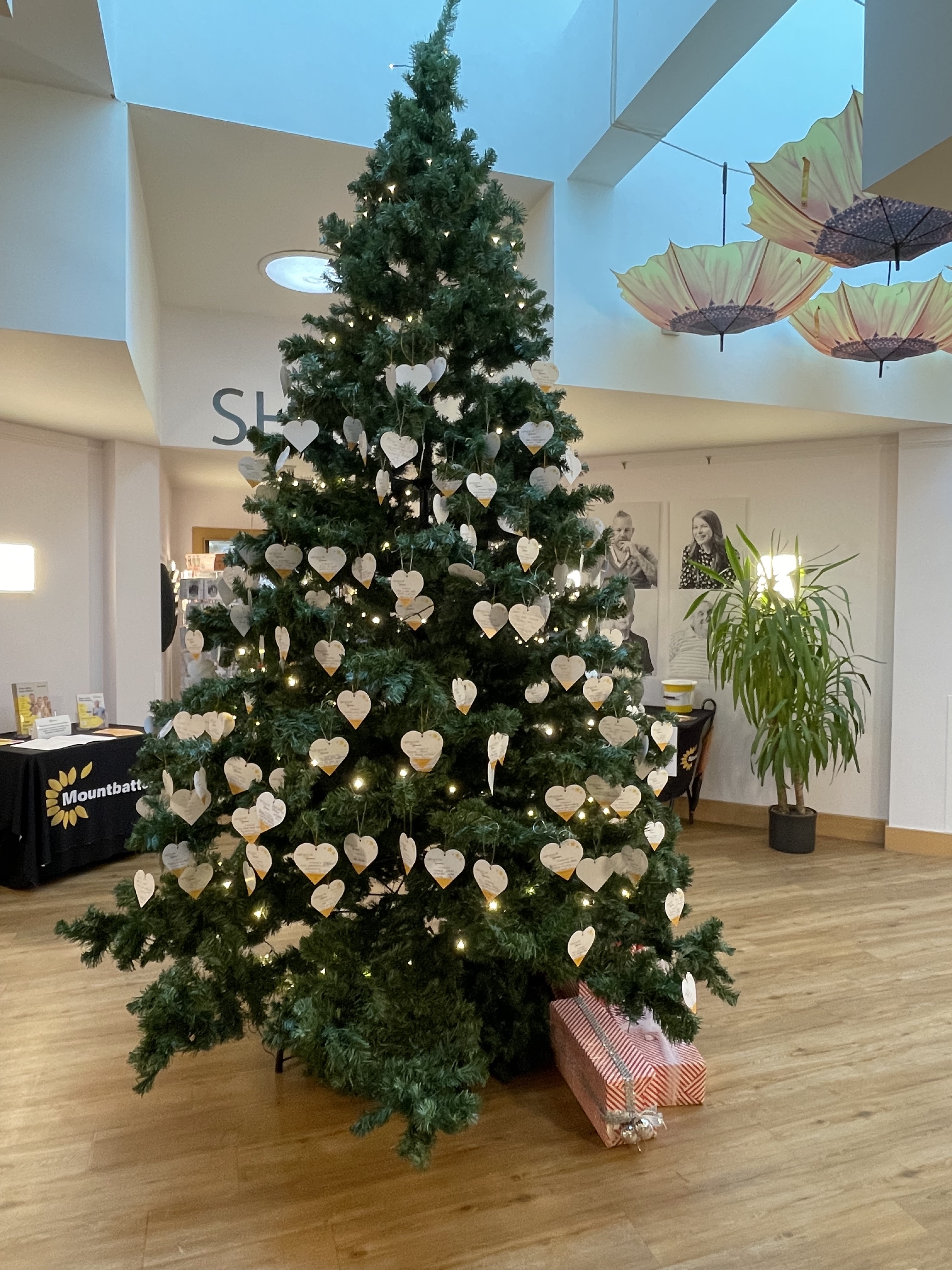
Inside the largest of those trees is bedecked with individual messages of remembrance, part of Mountbatten’s annual, Light up a Life event… Tia made a rough count and came up with a total of 231. Most of these cards name a person or people, lovingly remembered. Sometimes a card will include a little more, for example, a drawing or very short comment, as much as can be held on one small, heart-shaped card.
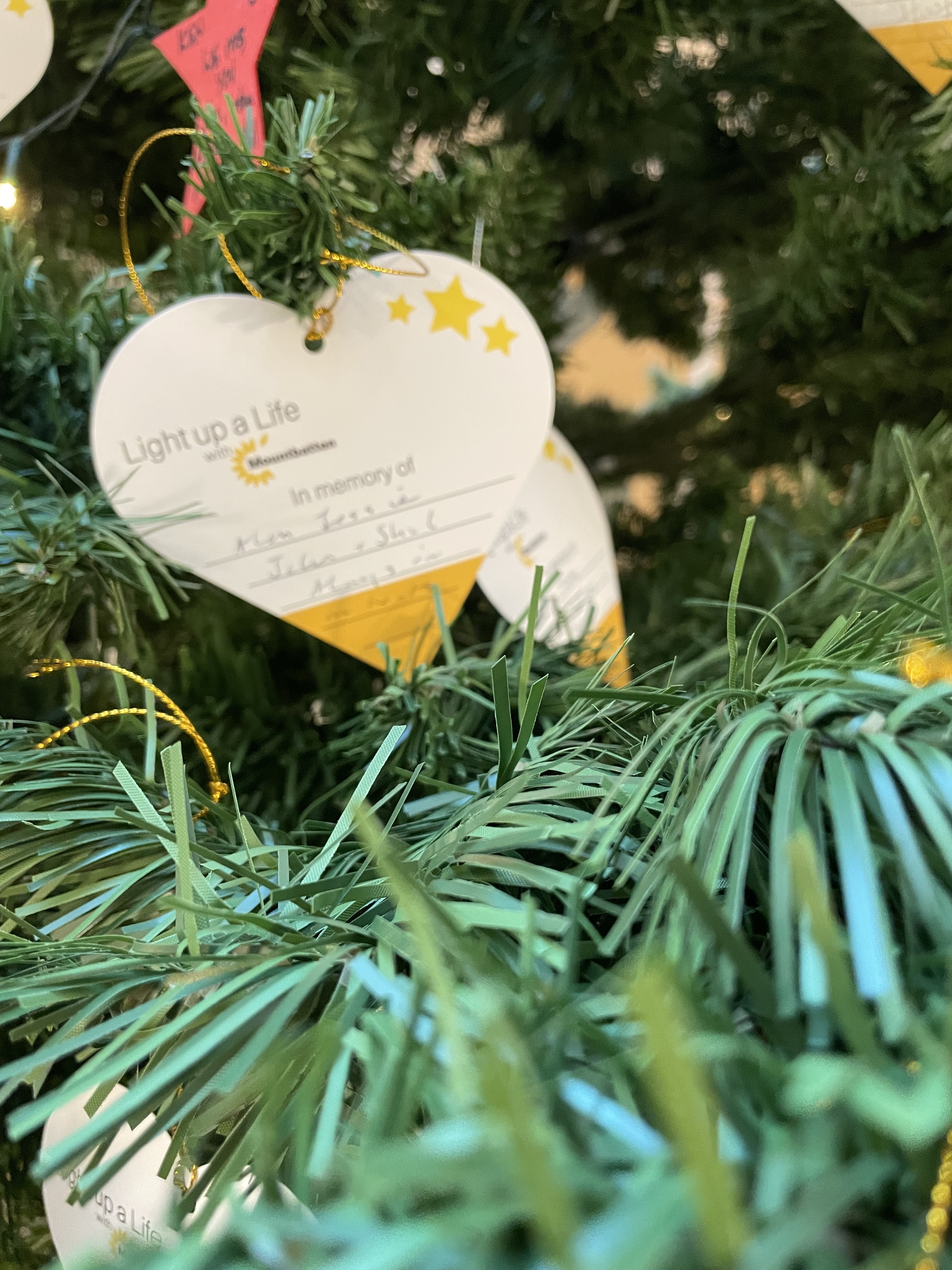
But of course, none of those stories is ever short. Standing near to the tree, Director of Catering, Vera Mircescu reflected on how each small tag is but a pointer to a rich and detailed story….
*
The weather that day was changeable – rain clouds and intermittent sunshine – shadow and light… It made Tia wonder… Were her eyes were deceiving her when across the room she spied Santa (bearing a slight resemblance to one of the social activities coordinators, Jane)? And why was Santa accompanied by Jane’s colleague Ally who seemed, improbably, to be riding a giant polar bear?

The day before that, there was music. The Moody Blues Piano, featured in an earlier blog on this website was in action… Have Yourself a Merry Little Christmas. Silent Night. Jingle Bells. I’m Dreaming of a White Christmas….
It turned out that the musician was Mountbatten’s CEO, Nigel Hartley, originally trained as a concert pianist and music therapist…. So, as we asked last year on these pages, what can happen when the CEO of a major hospice is also a musician and a trained music therapist?
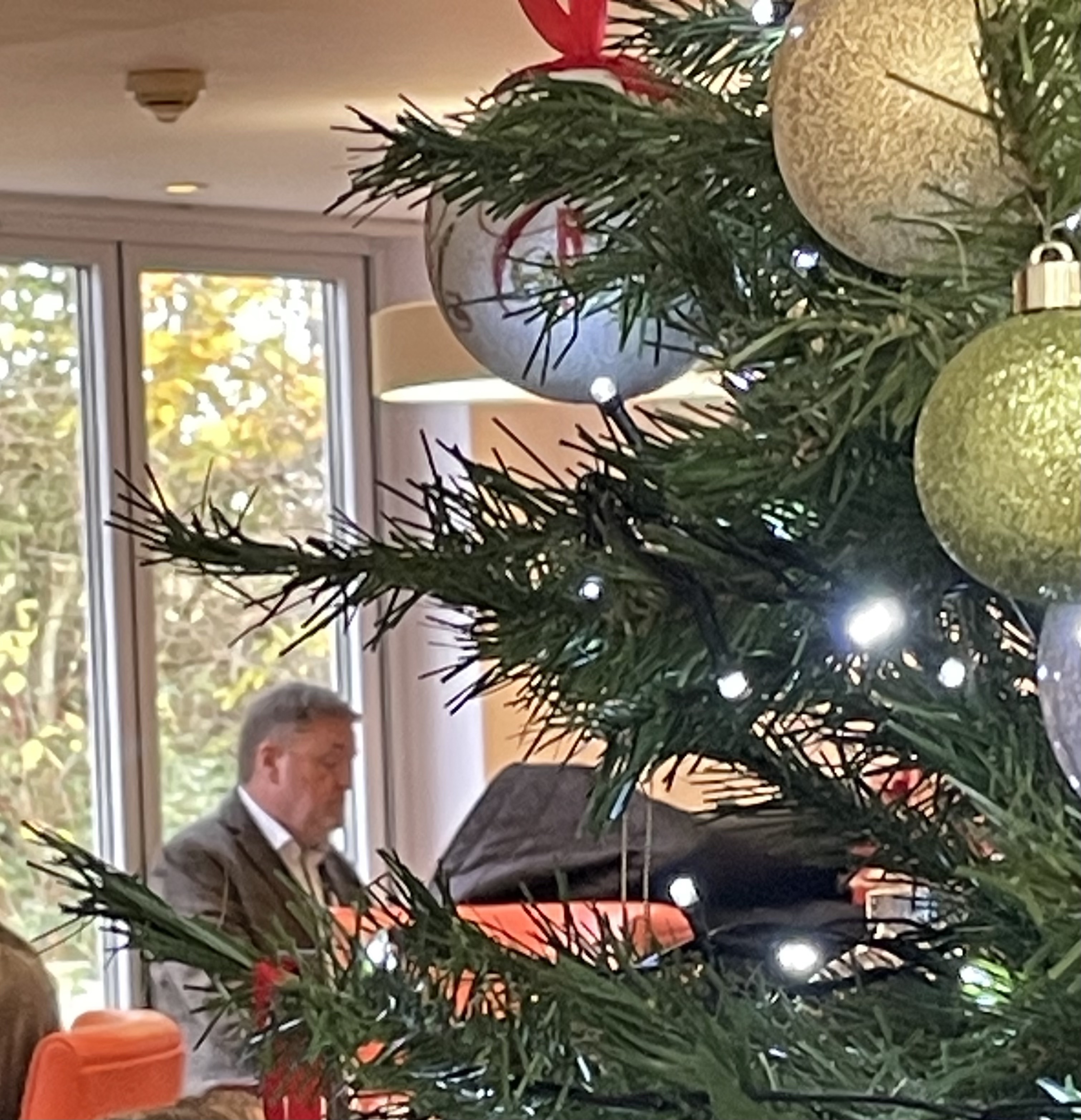
No fanfare. No big deal about how it was the CEO giving a concert. Someone up by the café counter, sounding unsurprised, asked, “oh, is that Nigel?” and turned back to whatever it was they had been doing.
The music was unobtrusive, almost questing, quietly rendered. Phrases stretched out to include the café’s ambient sounds to feature them, it seemed, as part of the ensemble…
- Silent Night… (‘tuna with cheese’, ‘did you enjoy that?’, quiet singing of phrases from around the room…)
- In the Bleak Mid-winter (‘you’ve got a blood test soon’…’I’m gonna run, byeeee!’…)
- Mary’s Boy Child (‘Byyyyeeee. See you Saturday. Thanks… See ya later. Bye bye’… Dum, de, dum, the angels sing, dum de dum dum de-e-e, Dum de dum dum de-dum-dum, because of Christmas Day. I can’t remember all the words’…)
*
In the classical sense, Nigel is a ‘virtuoso’ musician. But the virtuosity he employed in this concert was of a different kind, the kind Tia has seen occasionally among seasoned music therapists. It might be called, ‘social virtuosity’ a term coined by (virtuoso) improvising musician, Maggie Nicols. In a recent publication, Nicols describes how, ‘in countless sessions, I have consistently experienced music with profound meaning in the sense of human connection, joy, innovation, and skill’ (Nicols 2023: 86). Social virtuosity transcends a focus on the performer and their ‘exhibition’ of skill. It places music neither in the limelight, nor in the background. Instead, it understands music as a medium that can hold, be shaped by, and frame the things that are happening around it.
*
The late Mercédès Pavlicevic once wrote about what happens in community music, ‘between beats’. She spoke of the ‘magic moments’ that lasted, ‘no more than seconds’ and which seemed to, ‘signal participants’ experiences of shared meaning, pleasure, dignity and collective belonging in “the present moment” (here Pavlicevic is referring to psychologist Daniel Stern’s work on the present moment in psychology and daily life).
People chipping in with little phrases and snippets, finishing up closing cadences, singing the bits they knew… Small, perfect, meaningful gems…discreet, liminal music making, sometimes only barely audible… If you let your imagination wander, your eyes and ears might start to play tricks, the metallic clang of cutlery standing in for sleigh bells for example… There were no actual reindeer (none that Tia spotted anyway) but there was one very beautiful old dog, shod in protective socks, who mingled as if he were hosting the event, greeting guests by sociably sniffing their tapping toes. His face was eloquent …

The origin of the word concert lies in the Latin concertante: agreement, accord, pact… That etymology points to a renewed notion of what a ‘concert’ can be, and how a ‘concert’ contains and is enriched by distributed forms of ‘virtuosity’. So, the word – concert – literally underscores ‘concerted’ effort involved in being together meaningfully in time and place so that, within a present moment ‘magic’ may occur.
Further Reading:
Nicols, Maggie. 2023. Social Virtuosity. Chapter 7 in, Devinish, L and C. Hope (Eds), Contemporary Musical Virtuosities. London: Routledge.
Pavlicevic, Mercédès. 2012. Between Beats: Group Music Therapy Transforming People and Places. In R. MacDonald, G. Kreutz and L. Mitchell (Eds), Music, Health and Wellbeing. Oxford: Oxford University Press.
Stern, Daniel. (2004). The Present Moment in Psychotherapy and Everyday Life. New York: Norton.
 Island Life and Death
Leave a comment